A digital copy of a Malay manuscript can show a page that was written long before it was uploaded. It can also show a version copied long after the events in the story. When you use an online image in a Malaysian Sejarah assignment, label the date beside the thing it dates: the event described, the surviving copy or the image you opened. Those dates are not interchangeable.
Malaysian news coverage in 2020 discussed proposals to make more digitised Malay manuscripts available through universities and heritage institutions. Wider access is useful for a history class, but it also raises a simple reading question: what exactly did the catalogue date? You do not have to read the entire manuscript, or be able to read Jawi, to start checking its record.
Start by identifying the copy, not just the story
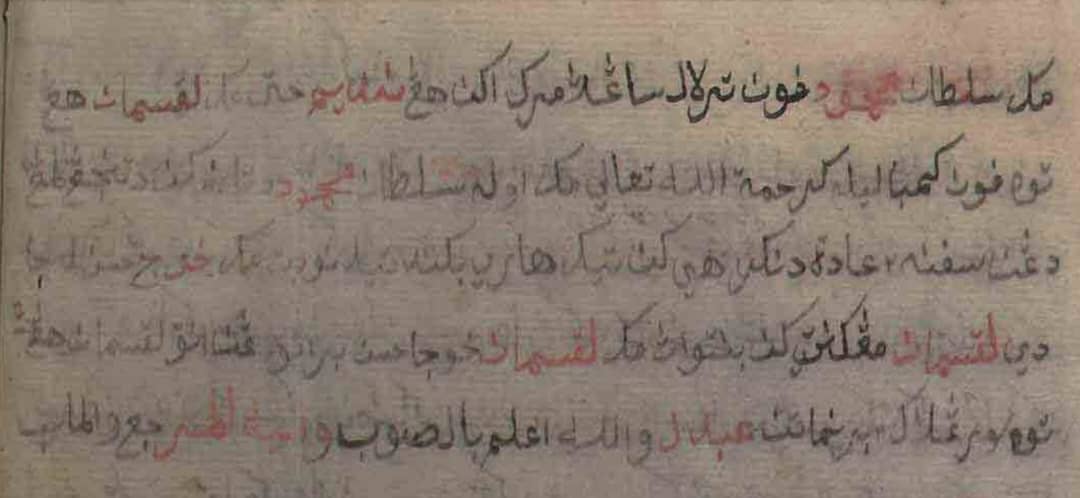
Take a digitised excerpt from Sulalatus Salatin、とも呼ばれます Malay Annals. A published manuscript study at Universiti Pendidikan Sultan Idris describes a version dated 1223 Hijrah, corresponding to 1808 in its account. The image can be captioned as an excerpt from an 1808 copy. Do not caption it as the original text composed in 1808 or as proof that the events on the page occurred in that year. The record identifies a particular witness to the text, not every version ever made.
If a record provides an institution and a shelfmark, copy both, then write the page or image number you looked at. A title alone may bring you several different copies. If one search result gives only the title and a year while another names the collection and copy, use the more precise record to check what is being dated. A date printed under a thumbnail may belong to the file rather than the original item.
If you cannot read the lettering, you can still distinguish the scan from its description. The script is part of the scanned object; the catalogue heading was typed later to help readers find it. Say which one you are using as evidence rather than treating both as the same source.
Test three labels against what the record supports
On three slips, write “this copy was made”, “the story describes”, and “the image went online”. Place 1808 on the first slip. If the catalogue does not give a date for the event described, leave the second slip blank rather than copying 1808 onto it. If the file history gives a recent upload date, put it on the third. A blank is useful here: it says what kind of date you still need.
Imagine a classmate writes “In 1808, everything on the page happened.” Ask which feature of the record supports that. The year attached to the manuscript copy cannot answer the question. Now imagine someone writes “The manuscript was written this year” because the online page says it was recently updated. That is the reverse error. An update could change a description without changing the age of the object.
Write one modest source note that another pupil can check
A fair note could read: “This image shows text from a copy of Sulalatus Salatin dated to 1808. The year dates the copy, not the events it recounts.” If the question is about the historical date of an event, say what else you need, such as a separately dated record that discusses that event. Do not assume another edition of the same story is independent confirmation.
Try the method on a familiar object before returning to the archive. Suppose you copy a family recipe into a new notebook on Monday and photograph it on Friday. Monday dates this written copy; Friday dates the image. Neither tells your class when your family first used the recipe. This is not the same evidence as a manuscript catalogue, but it makes the three dates easier to keep apart.
Finish by reading your assignment caption without looking at the image. Can a reader tell what the date refers to? If not, add “copy”, “event” or “upload”. That small correction is often more valuable than adding a second number without an explanation.