
Malaysia’s educational system has prioritized STEM education since the early 2010s. While school districts around the country have been working for over two decades to provide a more comprehensive curriculum that encompasses science, technology, engineering, the arts, and math, access remains a challenge.
Students in high-poverty communities have fewer science materials and less access to advanced mathematics such as calculus and physics, according to research. According to similar research, students with disabilities have limited access. As a result, substantially fewer impaired students than their non-disabled counterparts finish with a STEM degree. Educators begin to ponder how STEM and coding abilities may be made available to everyone. Here are some ideas for bridging the gap:
1. Create an environment conducive to STEM success.
For starters, it’s critical to create a learning environment in which STEM students have the highest opportunity of succeeding. What type of vibe do you get from that? According to research, STEM education works best in schools where:
- The importance of student participation cannot be overstated.
- Lessons that are fun to learn are the norm.
- It’s a good idea to be able to learn from your mistakes.
- Collaboration is encouraged.
There must be some kind of educator buy-in for STEM to operate. Fortunately, evidence indicates that instructors support STEM/STEAM instruction and embrace its cross-curricular aspect, which benefits students. Before you can assess your school’s STEM accessibility, you’ll need to create the ideal atmosphere to make it happen.

2. Start teaching STEM at an early age.
When is it too early to begin STEM? Early STEM education has been shown to be beneficial. Even kindergarteners are capable of learning STEM and STEAM abilities. A five-year-old may not be poring over a trigonometry equation or coding code, but they can solve for x in a mathematical equation, detect patterns, and have a keen interest in all things artistic. STEM stimulates a child’s inherent interest as well. When children are young, their curiosity is generally at its height. They want to be able to ask questions, look for clues, and be guided in their search for solutions. STEM education begins at a young age, laying a foundation on which children can build. Furthermore, early access to the curriculum increases the likelihood that the curriculum will be continued throughout a child’s schooling.

3. Create a STEM or coding-related class project.
Consider including a STEM-focused class project in your curriculum. You can try making a hand crank winch or mimicking an oil leak by asking youngsters to extract oil from water, according to Rasmussen University’s list of 11 STEM projects. Students in an Oregon class were given the task of developing an app. They had to come up with a need for an app as a group, then design, code, test, and present it to a panel of professors.
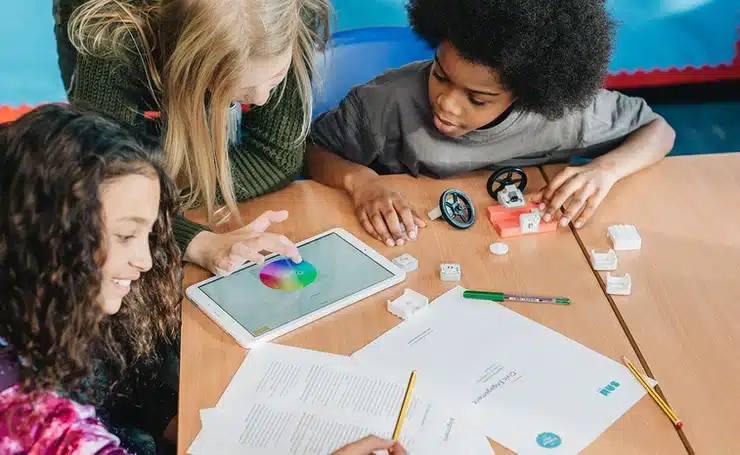
4. Consult a reputable STEM source.
It might be difficult to figure out how to improve access to STEM programming inside a school. As a result, many educators rely on SEACC to provide a reliable STEM curriculum that is accessible to all. SEACC helps K-8 educators bring coding to life with tools, courses, and support that are simple for any teacher in every class to deploy using app-enabled construction kits. SEACC guarantees that each lesson targets underrepresented and underserved students, in addition to having all of the course materials needed for each grade level.
Every session, for example, includes vocabulary activities for ALL students. As a result, everyone in the class can participate in the lesson, regardless of their proficiency in the English language. In contrast to text-heavy guidelines, which are more difficult for ALL children to understand, visual instructions provide additional support.
Lessons in economically challenged schools begin with the basics and progress from there. This type of advancement evens the playing field and provides an accessible entry point for all pupils. Hands-on exercises are incorporated into each session, and disabled students can benefit from the soft skills taught for each project. In addition, the visual nature of the lesson is advantageous.

A great STEM curriculum focuses on more than just a few courses; it also aims to develop critical thinking, problem-solving, and collaborative efforts. Students will benefit from these skills long after they leave the classroom. Everyone at SEACC is on a mission to ensure that every student has access to these lifelong skills since they think STEM can unlock potential in all students.